
The five principles of electoral law
Members of the European Parliament represent the citizens of the Member States of the European Union.






Information about the European elections

Eligible to vote are
all Germans within the meaning of Article 116 Paragraph 1 of the Basic Law, as well as all nationals of other member states of the European Union (citizens of the Union) who on election day
- have reached the age of 16
- have been resident or otherwise ordinarily resident in the Federal Republic of Germany or in the other Member States of the European Union for at least three months and
- are not excluded from the right to vote.
Germans entitled to vote in the German Bundestag under Section 12 (2) of the Federal Elections Act (so-called expatriate Germans) are also entitled to vote.
All eligible voters whose main place of residence is registered in Offenburg (deadline: 42nd day before the election) and who meet the requirements for eligibility to vote are automatically entered in the voters’ register of the City of Offenburg. Based on this entry in the voters’ register, voter notifications will be sent out in due course (at the latest on the 21st day before the election).
If you have not received a voter’s notification by this time, you should contact your polling station to check whether you have been properly entered on the electoral roll.
Information for ex-Offenburg residents:
Germans living abroad (so-called “Auslandsdeutsche”) are not automatically included in the electoral roll, but can apply to be entered on it.
For this purpose, a written application must be submitted for entry in the electoral roll of the last German municipality of residence. The application must be submitted to the electoral office of the municipality within a prescribed period (21 days before the election). The application also serves as an application for a polling card.
Care must be taken to submit the application for inclusion in the electoral roll in good time and to apply for postal voting documents at the same time.
Detailed information and the application form for entry in the voters’ register can be found on the website of the Federal Returning Officer under the following link Germans abroad – The Federal Returning Officer
Information for EU citizens:
There are two ways in which EU citizens can be entered on our electoral roll:
- Automatic entry
EU citizens entitled to vote who have already been entered in a voters’ register in the Federal Republic of Germany at their request in a previous European election (since June 13, 1999) are automatically entered, provided they have not moved abroad in the meantime. Like all eligible voters, they will then receive a voter’s notification from us by the 21st day before the election at the latest. After moving away from Germany and then moving back to the Federal Republic of Germany, you must submit a new application to be entered in a voters’ register.
- Registration on request
EU citizens who are not entered in a voters’ register ex officio (see above) must submit a formal application to be entered in a voters’ register. The application must be received by the Offenburg city administration no later than the 21st day before the election. The deadline cannot be extended.
The application form must be signed personally and by hand by the person submitting the application and the original must be sent to the City of Offenburg.
The application form can be downloaded from the following link Union citizens – The Federal Returning Officer. In addition, printed application forms are available from the City of Offenburg, BürgerBüro, Fischmarkt 2, 77652 Offenburg.
- Registering to vote in another EU country
EU citizens who wish to vote in the European Parliament elections in their home country should contact the competent authority in their home Member State for further information. The diplomatic missions of the respective countries of origin can provide further legal and procedural information.
If you are officially entered in a voters’ register in Germany, but wish to exercise your right to vote in your home Member State, you must apply in writing to the City of Offenburg by no later than the 21st day before the election to not be entered in the voters’ register. This also applies to all future European elections until another application for entry in the voters’ register is submitted.
The application form can be downloaded from the following link Union citizens – The Federal Returning Officer. In addition, printed application forms are available from the City of Offenburg, BürgerBüro, Fischmarkt 2, 77652 Offenburg.
In accordance with the legal requirements, the European Parliament will consist of 720 members from the 2024 European elections (currently 705 members). 96 of these MEPs are reserved for German parliamentarians.
The European Parliament is elected according to the principle of proportional representation. Each voter has one vote. With this vote, you choose the electoral list of a party or another political association. The respective voting shares of the various parties and political associations determine the distribution of the 96 German MEPs in the European Parliament in accordance with proportional representation. This means, for example, that if party A receives 20 percent of the votes nationwide, party A also receives 20 percent of the German seats in the European Parliament.
How do you vote at the polling station?
The polling stations are open on election day in Offenburg, in the city center and in the districts, from 8 am to 6 pm. The name and address of your polling station are printed on your polling card.
Every eligible voter has one vote, which can be used to elect a party.
No possibility to vote at the polling station?
If it is not possible to vote in person at the polling station on election day, it is possible to vote in advance by postal vote. You can find details on the procedure and how to apply for postal voting here: Postal voting

1. voting in person at the polling station - arrival at the polling station
To vote on election day, voters must identify themselves at their assigned polling station with their polling card or identity document.
2. verification of eligibility to vote
The electoral board checks voters' eligibility to vote using the electoral roll. All eligible voters on this list then receive a ballot paper.
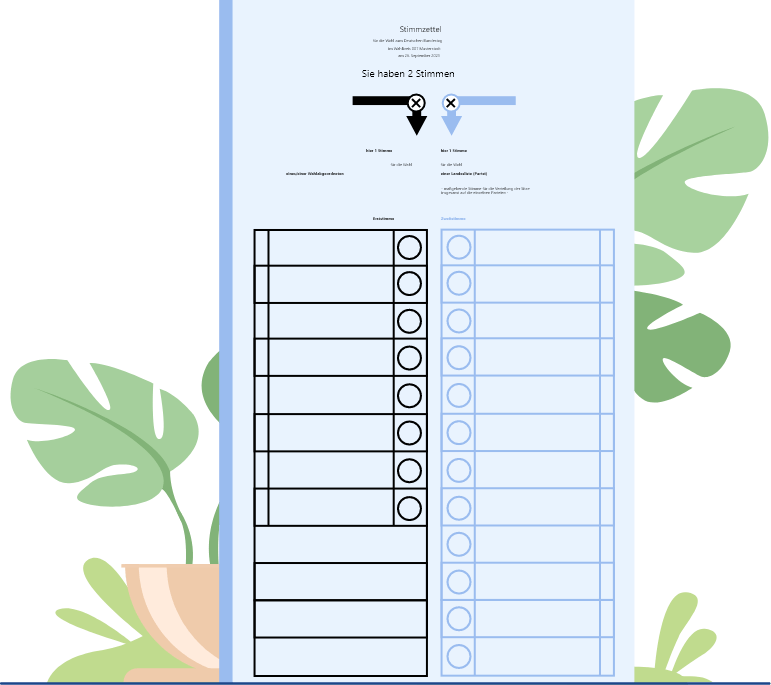
3. receipt of the ballot paper
Voters receive the ballot paper for the European elections.

4. voting booth
Voters go into the polling booth to ensure the secrecy of their vote.
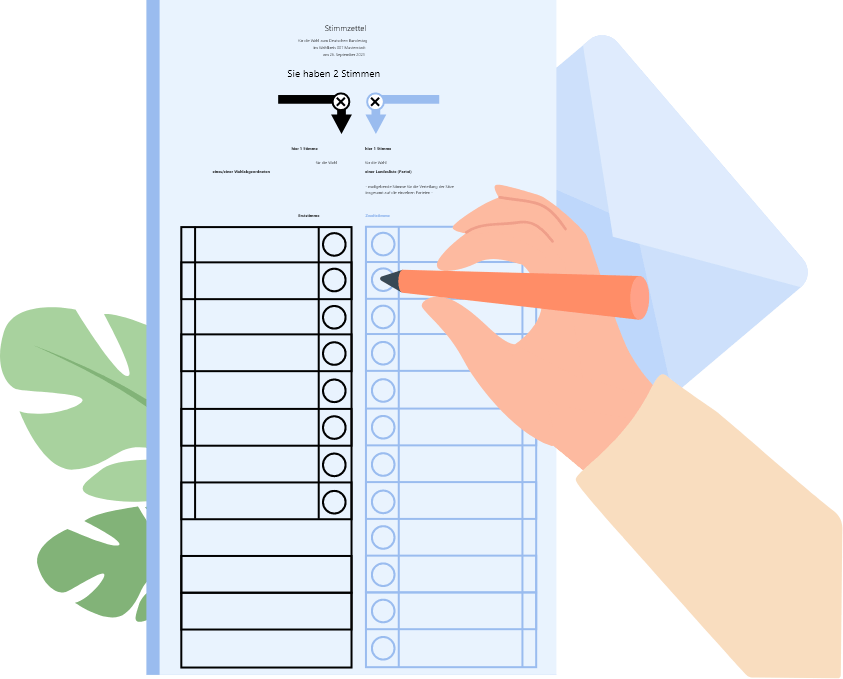
5. casting the vote
In the polling booth, eligible voters can mark their choice on the corresponding field on the ballot paper (e.g. by ticking it).
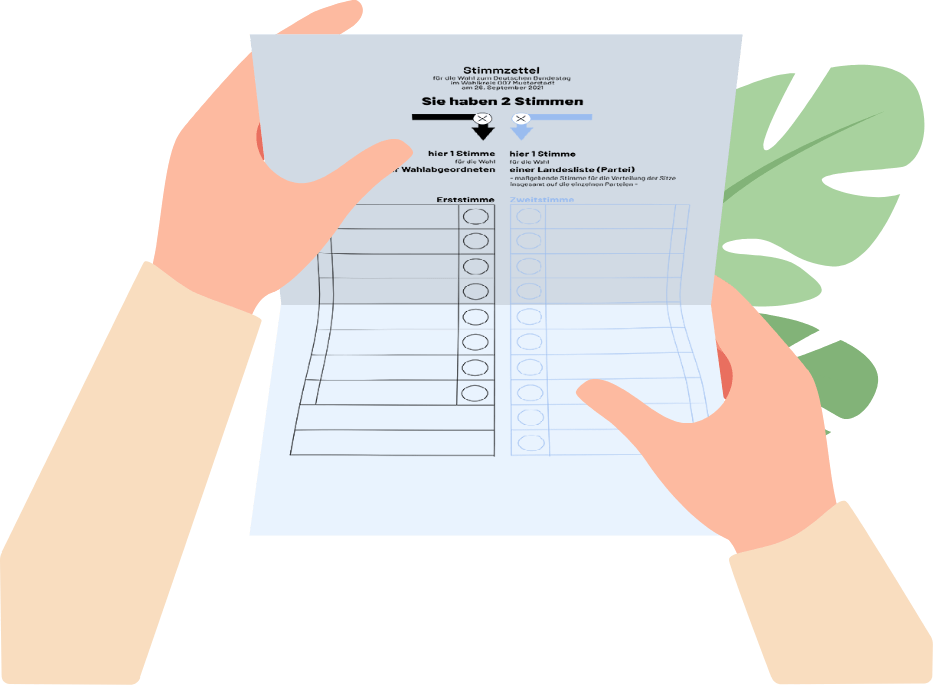
6. fold the ballot paper inwards
After casting their vote, voters fold the ballot paper so that their vote is not visible.

7. deposit ballot paper in ballot box
Voters leave the polling booth and drop the folded ballot paper for the European elections into the ballot box.
Find your polling station
The polling station is printed on your polling card. If you do not have it to hand, you can find your polling station here:

Topic
Federal election
Topic
State election