
The five principles of electoral law
In local elections, voters determine the composition of municipal councils, local councils and district councils.





Information about the municipal and local council elections
Eligible to vote are
all Germans within the meaning of Article 116 (1) of the Basic Law,
and all nationals of other Member States of the European Union (EU citizens) who, on election day
- have reached the age of 16
- have lived in the municipality – Offenburg – for at least three months (note: for the district council, the district – Ortenaukreis – counts for this regulation and for the local councils the respective district counts as a residential area)
- are not excluded from the right to vote.
All eligible voters will be sent their election notification by the City of Offenburg by the 21st day before the election and, unlike for all other elections, will also be sent the ballot papers for the municipal elections (municipal council, local council and district council elections) in advance. Sending the ballot papers in advance simplifies the election, among other things, as citizens can prepare the ballot paper at home in peace and quiet and thus enable a speedy election or submission of the ballot papers at the polling station.
(Despite this option, ballot papers may of course also be filled in at the polling station).
However, due to the complexity of the different elections and the number of votes, it is advisable to look at the ballot papers beforehand.
The ballot paper for the European elections is not delivered in advance; it may only be handed out to postal voters and at the polling station.
The allocation of votes is subject to a number of special features which must be observed and which offer voters various options for casting their votes:
The exact number of votes can be found on the respective ballot paper for the municipal council, local council and district council elections. For example, you can cast 40 votes for the municipal council for the city of Offenburg, as 40 people are to be elected to the municipal council.
Special feature, the principle of proportional and majority voting
Proportional representation exists if more than one election proposal/list is to be elected. If there is only one election proposal/list or none at all, elections are held in accordance with the majority voting system.
- Variant, several election proposals/lists are available, i.e. proportional representation.
The City of Offenburg has ballot paper blocks for the municipal council and the local councils. First separate out the individual ballot paper of the party or voters’ association on which you want to cast all or the largest number of your votes.
Do you only want to vote for this party or voters’ association and should the pre-printed candidates each receive one vote? Then simply cast this single ballot paper unchanged – i.e. without any marking at the election.
If you want to give individual candidates more than one vote (cumulate) or vote for candidates from several lists (variegate), you must mark the ballot paper.
Important: If you make markings on the ballot paper, only the positive markings on the ballot paper count. This means that a 1 or 2 or 3 or another clear marking must be added to all desired candidates. Candidates without a marking do not receive a vote.
If you cast all 40 votes (e.g. for the local council), your vote carries full weight.
However, count carefully so that you do not cast more than 40 votes, otherwise the entire ballot paper will be invalid.
The election of local councillors follows the same election principle if proportional representation applies.
Special feature, cumulation and panashing
Accumulate: You can give individual candidates up to three votes, this is also known as accumulating votes. Simply write the desired number of votes 1 or 2 or 3 in the box behind the desired candidates.
Panache: You can also include candidates from other parties or voter associations on your individual ballot paper. Each individual ballot paper has free lines for this purpose, in which you can enter the candidates either by number or by name so that no confusion is possible. You can also cast up to three votes for candidates transferred in this way.
- Variant: one election proposal/list or no election proposal/list at all, i.e. majority election.
In this case, there is no possibility of cumulation and panache.
If you wish to cast the ballot paper unchanged, you do not need to mark it and all candidates will receive one vote each.
If you only want to vote for individual candidates, you must mark the ballot paper.
This information can also be found on the individual ballot papers. The first page of each ballot paper describes exactly how many votes you can cast and which voting principle applies.
How do you vote at the polling station?
The polling stations are open on election day in Offenburg, in the city center and in the districts, from 8 am to 6 pm. The name and address of your polling station are printed on your polling card.
In the city of Offenburg, 40 municipal councillors are to be elected for 5 years.
The local councils differ in their composition, with 8 local council members to be elected for 5 years in the village of Bühl, 10 local council members in the villages of Bohlsbach, Elgersweier, Fessenbach, Griesheim, Waltersweier, Weier and Windschläg, 12 local council members in the villages of Rammersweier and Zunsweier and 14 local council members in the village of Zell-Weierbach.
No possibility to vote at the polling station?
If it is not possible to vote in person at the polling station on election day, it is possible to vote in advance by postal vote. You can find details on the procedure and how to apply for postal voting here: Postal voting

1. voting in person at the polling station - arrival at the polling station
To vote on election day, voters must identify themselves at their assigned polling station with their polling card or identity document.
2. verification of eligibility to vote
The electoral board checks voters' eligibility to vote using the electoral roll. All eligible voters on this list then receive a ballot paper.
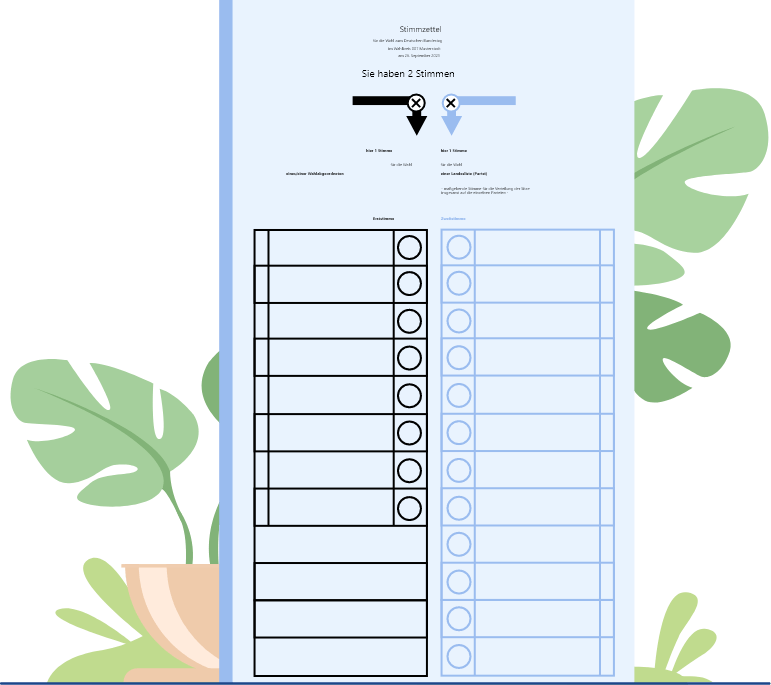
3. receiving the ballot paper at the polling station if the ballot paper has not yet been prepared at home.
Voters receive the ballot paper for the municipal council elections and, depending on their eligibility to vote, the ballot paper for the district council and, if applicable, local council elections.
As the European elections are held at the same time as the municipal elections, voters also receive the ballot paper for the European elections. This ballot paper will only be handed out at the polling station or sent by post.

4. voting booth
Voters go into the polling booth to ensure the secrecy of their vote.
5. casting the vote
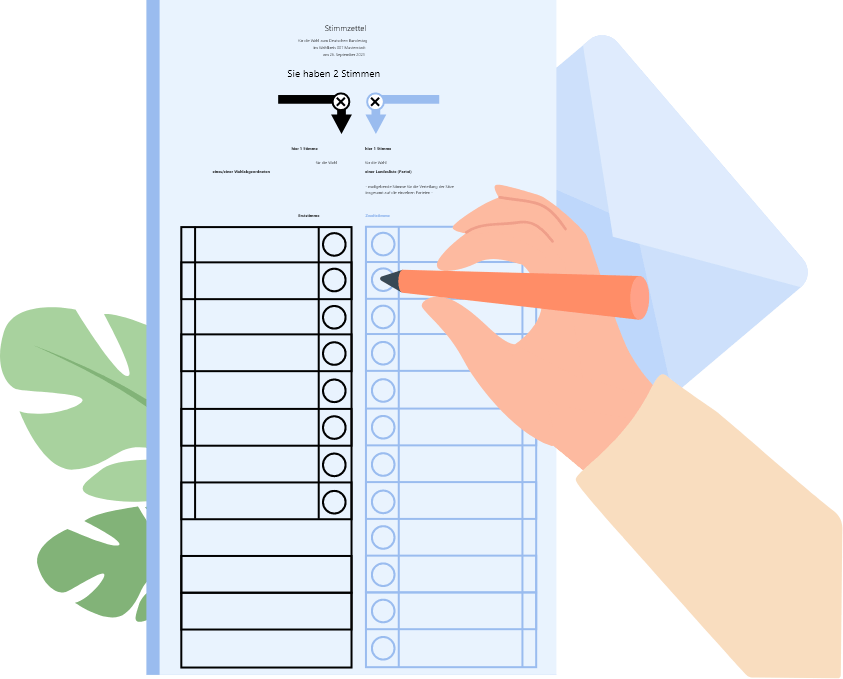
In the polling booth, eligible voters can mark their choice on the corresponding field on the ballot paper (e.g. by ticking it).
This can be done as follows:
In Offenburg, we have one ballot paper block each for the municipal council and for the local councils, so you can first cut out the individual ballot paper of the party or voters' association on which you want to cast all or most of your votes.
If you only want to vote for this party or voters' association and the pre-printed candidates should each receive one vote, then simply cast this single ballot paper unchanged - i.e. without any marking at the election.
If you want to give individual candidates more than one vote (cumulate) or vote for candidates from several lists (variegate), you must mark the ballot paper.
Important: If you make markings on the ballot paper, only the positive markings on the ballot paper count. This means that a 1 or 2 or 3 or another clear marking must be added to all desired candidates. Candidates without a marking do not receive a vote.
If you cast all 40 votes for the municipal council, your vote carries full weight. The number of votes is different for local councillors. The exact number of votes that can be allocated can be found on the respective ballot paper for the local council.
Count carefully so that you do not cast more than the permitted number of votes, otherwise the entire ballot paper will be invalid.
6. fold the ballot paper inwards
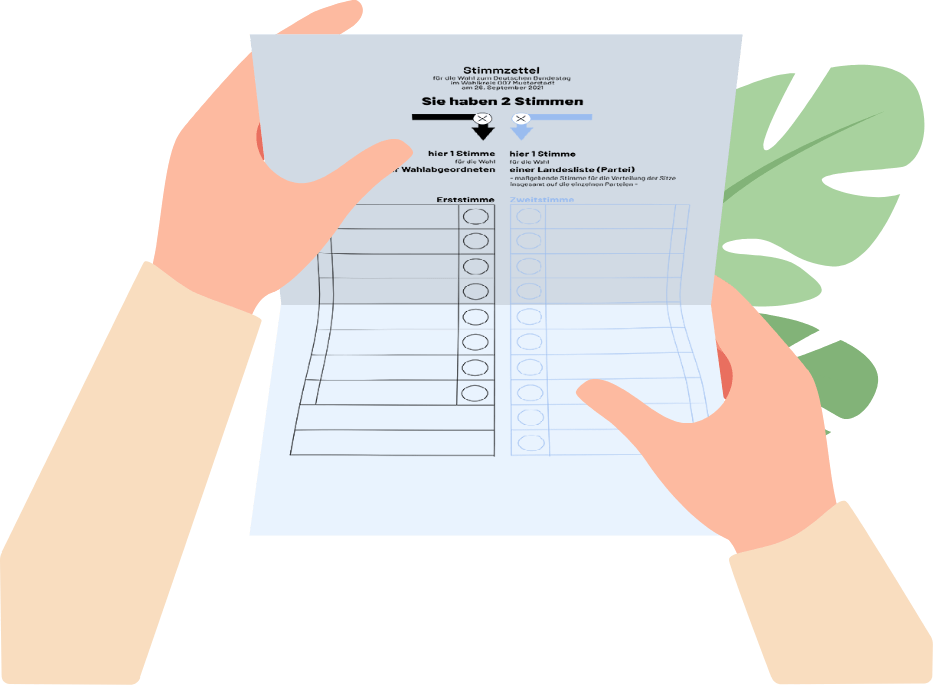
After casting their vote, voters fold the ballot paper in such a way that their vote is not visible and place the ballot paper(s) in the ballot paper envelope previously handed out.

7. deposit ballot paper in ballot box
Voters leave the polling booth and drop the ballot paper envelope with the ballot paper(s) for the municipal election into the marked ballot box.
Find your polling station
The polling station is printed on your polling card. If you do not have it to hand, you can find your polling station here:

Topic
Federal election
Topic
State election